
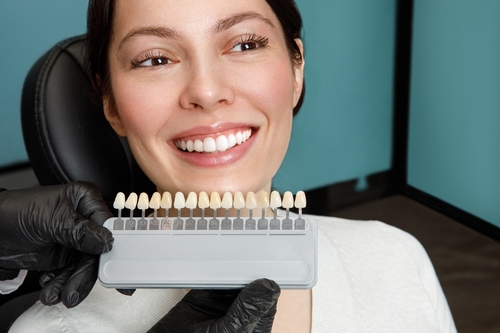
Teeth whitening is usually viewed as a cosmetic touch-up, but it has a much broader reach in dentistry. You do not need a full set of natural teeth to benefit from a brighter shade, and it is not limited to those seeking small refinements. We often incorporate whitening into broader treatment plans such as full-mouth reconstruction or smile makeovers because color is one of the key elements that ties everything together. When we restore your smile with dental implants, crowns, or veneers, we look at the entire picture, not just the individual parts. Whitening becomes the tool that helps set the baseline, so every new restoration blends with the shade you want. It supports the technical work by giving us a consistent reference point and giving us more control over the final look.
Professional vs. Store-Bought Teeth Whitening
Professional whitening and store-bought products use the same basic chemistry, but they behave very differently. Think of peroxide like a signal that tells stain molecules to break apart. When we supervise your whitening, we provide a formula strong enough to do the job efficiently. The reaction happens faster, the shade change is more noticeable, and the process follows a predictable curve because you are using a controlled system.
Store-bought strips, pens, and generic trays use a much weaker version of the same ingredient. The signal is faint, so it takes longer for stains to respond. You might see a slight lift over several weeks, but deeper discoloration often stays put because the concentration is simply too mild.
When you use our take-home whitening kit, you get a clear plan and materials that work at the right strength. We explain how to apply it so every surface gets covered, and we check in on your progress so you know the shade is moving in the right direction. With periodic touch-ups and consistent home care, professional whitening usually lasts longer than anything you can buy off the shelf.
When Teeth Whitening Fits Into Your Treatment Plan
Whitening becomes especially helpful when your treatment plan involves new crowns, veneers, or bridges. Even if your natural teeth are in good condition, their current color sets the benchmark for every restoration we create. Ceramic and composite materials are shade-matched to the surrounding teeth at the moment we take records. If your enamel brightens after that point, the restorations stay exactly as they were made, which can lead to a “two-tone” appearance where the new work looks dull in comparison.
To avoid that outcome, we usually recommend whitening before we finalize any restorations. We first address active concerns, such as decay or gum inflammation, so the foundation is healthy. Once we know which teeth need replacement, we help you choose a target shade that aligns with your long-term goals. You whiten until the shade stabilizes, and then we record that final color for the crowns or veneers.
Why Whitening Works on Teeth but Not Restorations
Whitening works only on natural enamel because enamel behaves like a microscopic sponge. Peroxide slips through those tiny openings, breaks apart stain molecules, and lightens the tooth from within. Restorations respond differently. Porcelain, ceramic, and zirconia are engineered to be dense and non-porous, so there is no pathway for peroxide to enter. Once a crown, veneer, or bridge is fabricated and fired, its shade is set. Your natural teeth may brighten with whitening, but the restoration keeps the exact color it had on day one.
Caring for the restoration helps it maintain that stable appearance. Brushing twice a day with a gentle, non-abrasive toothpaste protects the glazed surface. Daily flossing keeps the margins clean so the edges continue to blend with the surrounding enamel. Routine professional cleanings safely remove surface buildup, giving both your natural teeth and your restorations a clean, even look.
Over time, only your natural enamel will ever need a whitening boost. When the shade starts to fade, we can help you bring it back so your teeth stay aligned with the color of your restorations. It works like a simple recalibration: a brief touch-up keeps everything looking unified without altering the restorations themselves. The result is a consistent, well-matched smile that holds its appearance year after year.
Ready To Plan Your Ideal Smile?
If you want to explore how whitening can support your restoration, we can walk you through the options and show you how timing shapes the final shade. We’ll walk you through how timing works, how restorations are matched, and what to expect as your teeth brighten. We can also go over simple ways to keep everything looking even in the long run, including touch-ups and easy daily habits that support the color you want.
Contact Big Sky Dentures & Implants to schedule a consultation and learn more about incorporating whitening into your treatment.