
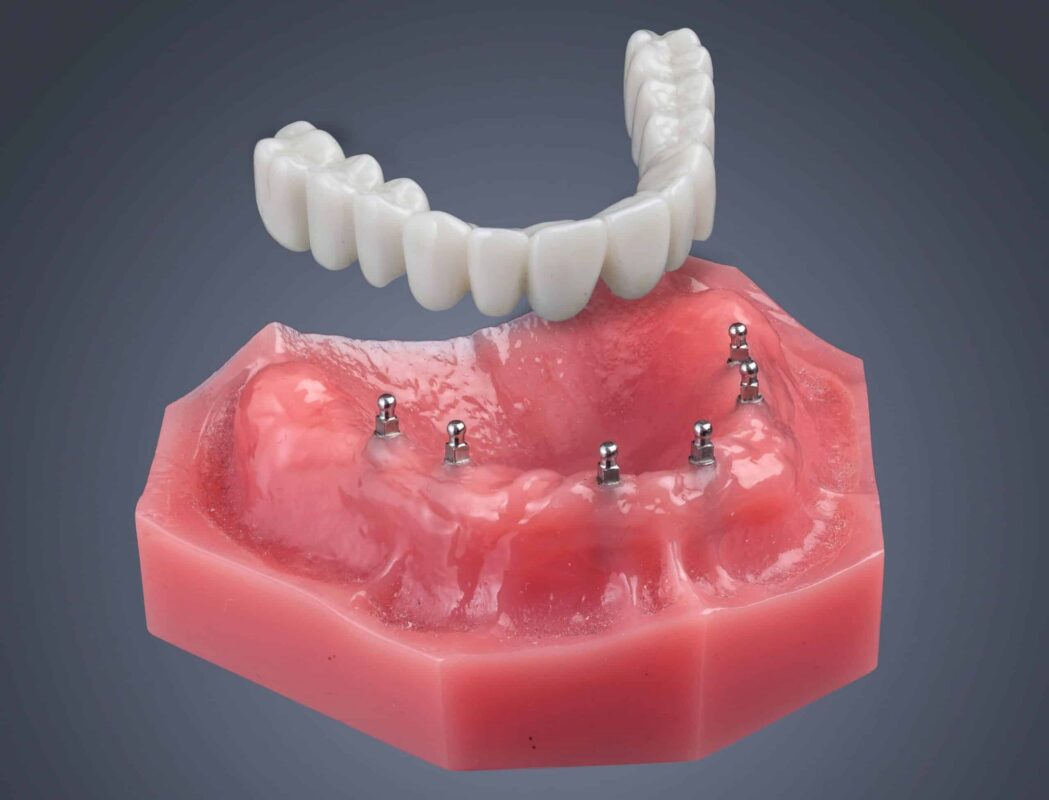
A roundhouse bridge falls within the implant denture category, yet it rarely resembles what most people expect a denture to look like. That contrast often creates confusion. If it replaces a full arch of teeth and relies on implants for support, why does it appear so different? The difference reflects a rethinking of what a denture should be. Full-arch tooth replacement is not new. What has changed is the way we think about dependability. When patients need to replace an entire row of teeth, the question becomes how to create something that feels stable and secure, and that functions as it should. A roundhouse bridge, which we often call our “golden option,” maintains the goal of restoring a full arch, while rethinking how that restoration is structured and supported.
What Is a Roundhouse Bridge?
A roundhouse bridge replaces all the teeth in your upper or lower jaw with one connected restoration. Instead of rebuilding your smile tooth by tooth, we restore the entire arch as a single unit.
The name comes from its shape. Your jaw forms a natural horseshoe-like curve from one side to the other, and we design the bridge to follow that same U-shaped contour. When you run your tongue along the inside of your cheeks, you can feel that gentle arc. The roundhouse bridge mirrors that outline, so it fits the way your arch was meant to.
The entire arch is milled as one solid piece, often from durable materials such as zirconia. Instead of separate crowns placed side by side, the teeth are fabricated together as a single full-arch prosthesis. We then secure that restoration to several dental implants placed in your jawbone. Those implants serve as anchors beneath the surface. They hold the arch firmly in position and distribute bite pressure across the entire structure when you chew.
Depending on your treatment plan, we may design the bridge to remain permanently fixed or remove it during routine maintenance visits. In either case, you receive a full-arch restoration that is supported from within the jaw rather than resting on top of your gums.
How Mini Dental Implants Support a Roundhouse Bridge
The number of implants we use to support a roundhouse bridge depends on several factors. Your bone volume, jaw anatomy, and whether the restoration will remain permanently fixed or be removable for maintenance all shape that decision. At Big Sky Dentures & Implants, we evaluate each of these elements carefully so your treatment plan fits your specific needs.
We use mini dental implants to support roundhouse bridges. Mini dental implants, also called one-piece implants, measure less than 3 millimeters in diameter. A one-piece implant is a single, solid unit that combines a root-like post that anchors in the jawbone with a connector that supports the prosthesis. Traditional implant systems are made from separate parts, with the implant post placed first and the connector attached later.
The mini implant’s smaller size allows for a minimally invasive placement. We numb the area with local anesthetic, create a small pilot opening through the gum and into the bone, and gently thread the self-tapping implant into position. We do not reflect large sections of gum tissue or place sutures. Patients typically experience minimal bleeding, limited disruption of surrounding bone, and a shorter healing period.
When Bone Loss Affects Implant Placement
Mini dental implants can be especially valuable in certain clinical situations. One example involves older adults who have experienced substantial bone loss in the lower jaw, a condition often associated with frailty. Frailty is commonly defined by signs such as unintentional weight loss, weakness, exhaustion, slow walking speed, or low physical activity.
As the jaw narrows over time, placing larger implants may require additional surgical procedures such as bone grafting. Mini dental implants offer another pathway in cases like these. Their smaller diameter allows us to place them within available bone in many atrophic jaws. By anchoring within the existing bone structure, we can support a roundhouse bridge without extensive surgical intervention.
Frailty is one example among many. Bone density, medical history, and long-term restorative goals all influence whether mini dental implants are the right support system.
Find Out If a Roundhouse Bridge Is Right for You
A roundhouse bridge shows what can happen when full-arch replacement is built around dependable support. The structure beneath the teeth determines how secure that restoration will feel over time.
Bone structure and anatomy vary from person to person. The sooner we evaluate yours, the more flexibility we have in designing the right approach. If you are considering a roundhouse bridge, contact us today to book a consultation. We will evaluate your oral health and guide you toward the right solution.